
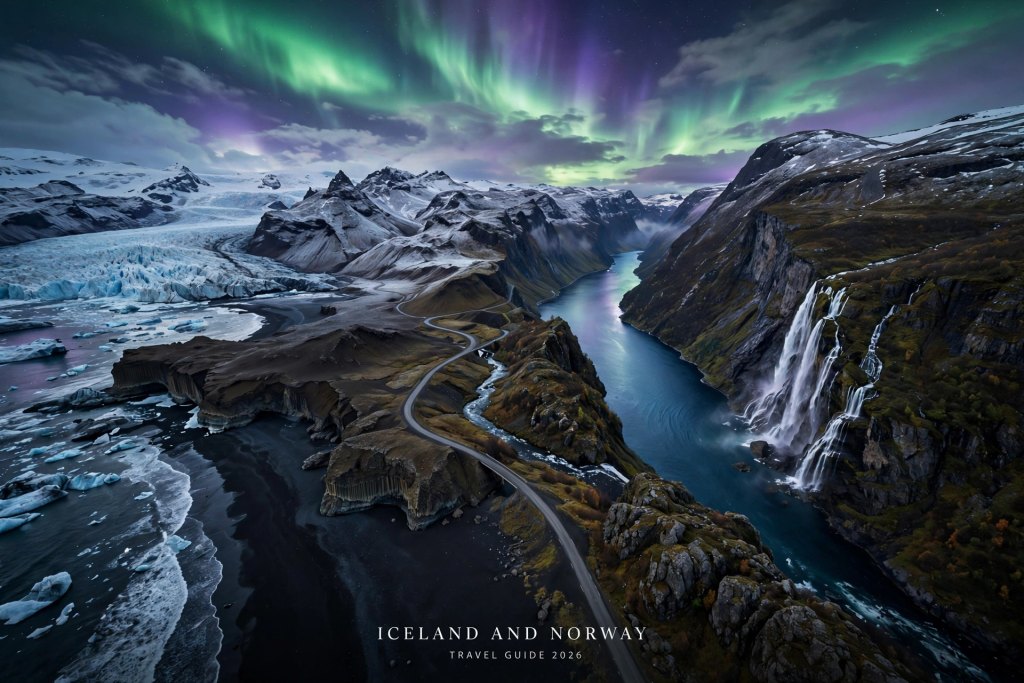
Iceland and Norway Travel Guide 2026
I still remember my first client who wanted to do Iceland and Norway together. “A lot of people ask me if Iceland and Norway look the same.” I laughed. After his trip, he called me and said they are poles apart. And that’s the truth.
If you are reading this for your 2026 trip, you are making the right choice. Doing them together makes a lot of sense now because flights between Reykjavik and Bergen are super cheap, and you save on Schengen visa hassle too. One visa, two crazy different worlds.
So let me break it down for you, no fancy words, just what actually works.
Best Time to Visit in 2026? It Depends What You Want
This is the question I get 10 times a day. And my answer is always – what do you want to see?
For Northern Lights (Late September to March)
This is the main reason people go. And 2026 is still part of Solar Maximum. Scientists are saying the lights will be super active till 2026-27. So you are lucky.
For best chance, you need dark skies and clear weather. I always tell people to stay at least 2 nights in one place. Don’t do “one night Northern Lights tour” in Tromso. It’s 50-50. Clouds ruin everything.
Best spots: Tromso and Lofoten in Norway, and Jokulsarlon and Vik in Iceland. September and March are my favorite because it’s not -20 degrees and you can still see the lights.
For Midnight Sun and Road Trips (June to August)
If you hate cold, this is your time. In June, sun literally doesn’t set in Tromso and in North Iceland. You can hike at 10 PM in full daylight. It feels weird but amazing.
Waterfalls are at their full power because glaciers are melting. Roads are all open, even highlands in Iceland. But yes, it’s expensive and crowded. Book hotels 5 months before, especially in Lofoten.
Shoulder Season – My Personal Favorite (May & September)
Less crowd, hotel prices drop by 30%, and you get a mix of both worlds. In May, you can still see snow but also green.
Best Places in Iceland – Don’t Just Do the Typical
Everyone goes to Blue Lagoon. I get it, it’s Instagram famous. But Iceland is so much more.
South Coast Waterfalls – Skogafoss & Seljalandsfoss
Skogafoss is massive. When you stand in front of it, you actually feel the spray on your face even from 100 meters away. And Seljalandsfoss, you can walk behind it. Take a raincoat. You WILL get wet, but the photo from behind the waterfall is worth it.
Jokulsarlon Glacier Lagoon and Diamond Beach
This place doesn’t feel real. Huge chunks of ice, some as big as a car, just floating in a lagoon. And then they wash up on the black sand beach next to it. That’s why they call it Diamond Beach, because the ice shines like diamonds. Go during sunset.
Golden Circle – But Start Early
It has Thingvellir National Park where two tectonic plates meet, Geysir which erupts every 5-7 minutes, and Gullfoss waterfall. It’s crowded. My tip: Start at 6:30 AM from Reykjavik. You will reach before the 20 tour buses. By 11 AM you are done and others are just arriving.
Reykjavik – More Than Just a Capital
Small city, colorful houses, Hallgrimskirkja church on top. Good for one evening. Try the famous hot dog at Baejarins Beztu. And if you like nightlife, Icelanders party hard on weekends.
Best Places in Norway – This is Real Norway
Look, Oslo is nice for museums but if you go to Norway and only see Oslo, you missed Norway.
Lofoten Islands – The Postcard is Real
Those red cabins on the water? They are called Rorbu. You can actually stay in them. You wake up, mountains in front, fjord below. No traffic, no noise. In winter, Northern Lights dance right above your cabin. In summer, you can kayak at midnight sun. Lofoten is slow travel. You need 2 days here minimum.
Geirangerfjord and Naeroyfjord
Both are UNESCO listed. And for a reason. I did the cruise last year. Steep mountains, waterfalls falling from 800 meters straight into the fjord. The famous Seven Sisters waterfall in Geirangerfjord – you have to see it. The boat goes so close you can feel it.
Tromso – The Northern Lights Capital
If Aurora is your main goal, base yourself in Tromso. It’s a small city above Arctic Circle. From here, guides take you chasing clear skies. Sometimes you have to drive 2 hours to find clear sky. And when you see it – green, pink lights moving like a curtain – you forget the cold.
Bergen – The Colorful Harbor Town
Bergen is called the gateway to fjords. The Bryggen wharf with colorful wooden houses is super photogenic. Take the Floibanen funicular up the mountain for the best view of the city and fjord.
Top Things To Do That I Recommend to Everyone
1. Fjord Cruise in Norway: Don’t skip. Even if it’s cold, stand outside on the deck for 10 minutes. The view is unreal.
2. Blue Lagoon vs Sky Lagoon: Blue Lagoon is famous, Sky Lagoon is more local and has a 7-step ritual. If you have time for one, I now suggest Sky Lagoon. Less crowded.
3. Glacier Hike in Iceland: Walk on a real glacier with crampons. Solheimajokull is good for beginners. You hear the ice cracking under you.
4. Dog Sledding in Tromso: Expensive but fun. Those huskies are crazy energetic.
5. Try Fermented Shark? Just kidding, don’t. But do try fresh cod in Lofoten.
My 8-Day Itinerary That Actually Works (Tested 50+ Times)
Day 1: Land in Reykjavik. Rest. Walk around city. Sky Lagoon in evening.
Day 2: Golden Circle early morning. Night in Vik area.
Day 3: South Coast – Skogafoss, Seljalandsfoss, Diamond Beach, Jokulsarlon.
Day 4: Fly Reykjavik to Bergen (2.5 hour flight, around $90 if booked early). Evening in Bergen.
Day 5: Naeroyfjord cruise from Bergen to Flam. Train Flam to Oslo is one of the most beautiful train rides in the world.
Day 6: Fly Oslo to Tromso or Lofoten. Northern Lights chase at night.
Day 7: Lofoten fishing village tour, kayak or hike.
Day 8: Fly back from Oslo.
This way you are not rushing. Many people try to do Iceland Ring Road in 3 days – you will just be driving.
How Much Will It Cost in 2026? Let’s Be Honest
Both countries are expensive. No sugar-coating.
Flights: From India/Europe to Iceland + Iceland to Norway + Norway back – roughly $600-$800 if booked 4 months early.
Hotels: $120-$200 per night for a decent 3-star. Lofoten cabins are $180-$250.
Food: A simple meal is $20-$25. A burger with fries can be $22. Supermarkets like Bonus in Iceland and Rema 1000 in Norway will save you money.
Activities: Blue Lagoon $80, Fjord cruise $70, Northern Lights tour $120.
For 8 days, budget around $2500-$3200 per person excluding international flights, if you share rooms. Solo will be more.
Packing List – What People Always Forget
Waterproof everything – jacket, pants, shoes. Not water-resistant, WATERPROOF. It rains anytime.
Thermal layers. Even in July, Lofoten can be 10 degrees.
Swimsuit. You need it for lagoons.
Power bank. Cold kills phone battery fast.
Eye mask for summer. Because sun at 11 PM makes sleeping hard.
3 Mistakes That Can Ruin Your Trip
Booking cheap shoes. You will walk on ice, rocks, wet sand. One slip and your trip is over.
Not booking Blue Lagoon / Lofoten cabins in advance. They get full 4-5 months before.
One night for Northern Lights. I have seen people cry because they had only one night and it was cloudy. Keep at least 2 nights buffer.
Final Words
Iceland is raw, wild, almost like another planet. Norway is calm, deep, like nature is showing off slowly. Together, they give you everything.
If you are planning for 2026, start now. Visa slots for Schengen are taking time, and good hotels in Lofoten are already getting booked for next September.
And if you want, we at GoIceTrip do this almost every week. We can make a plan based on your budget, not some copy-paste itinerary. Just message us.
Safe travels, and I hope you see the lights!